



 admission@niet.co.in
 +91-8010-500-700
Students may have innovative ideas, technical knowledge or even an early prototype, but building a startup involves challenges beyond developing a product. Founders need to understand customer needs, validate their ideas, develop a business model and determine how their venture can grow.
For first-time entrepreneurs, navigating these areas independently can be difficult. An Incubation Centre can bridge this gap by providing mentorship, infrastructure, business guidance and an environment where ideas can be tested and developed.
What Is an Incubation Centre?
An incubation centre supports early-stage entrepreneurs as they develop ideas into more structured ventures. Depending on the ecosystem, support may include mentorship, infrastructure, networking, prototype development and business guidance.
For students, an incubation centre can also function as an innovation hub, connecting them with mentors, experts and other entrepreneurs. This creates opportunities to learn from different perspectives while exploring solutions to real-world problems.
Turning Ideas Into Practical Solutions
A promising idea does not automatically become a viable startup. Founders first need to understand the problem they are solving and determine whether customers genuinely need their solution.
An incubation centre can help students validate assumptions, understand potential users and refine their business ideas. This can be especially valuable for students who have strong technical knowledge but limited experience with the commercial side of a venture.
Early feedback can help founders identify gaps and make improvements before investing significant time and resources.
Why Mentorship Matters for Student Entrepreneurs
Building a startup involves decisions around product development, customers, market strategy, team building and business operations.
Mentorship gives student entrepreneurs access to experienced professionals who can provide practical perspectives. Mentors may help founders question assumptions, identify potential gaps and develop a clearer approach towards their venture.
Rather than providing all the answers, effective mentorship can help students learn how to evaluate challenges and make more informed business decisions.
Building a Startup Ecosystem Through Collaboration
Entrepreneurship rarely happens in isolation. A startup may require technical, creative and business expertise, making collaboration an important part of the journey.
A strong startup ecosystem can bring students, entrepreneurs, mentors, researchers and professionals together. These interactions can encourage peer learning, exchange of ideas and potential collaboration.
For students, being surrounded by people working on different problems can also make entrepreneurship a more practical learning experience.
Infrastructure for Testing and Prototyping
Many student-led ideas need to be tested before they can develop into practical products or services. This is particularly relevant for technology-driven ventures that may require specialised facilities.
Incubation centres can provide workspaces, laboratories and prototype-development resources that allow entrepreneurs to move beyond the conceptual stage.
Developing and testing prototypes can help students identify technical limitations, collect feedback and improve their solutions before considering a wider launch.
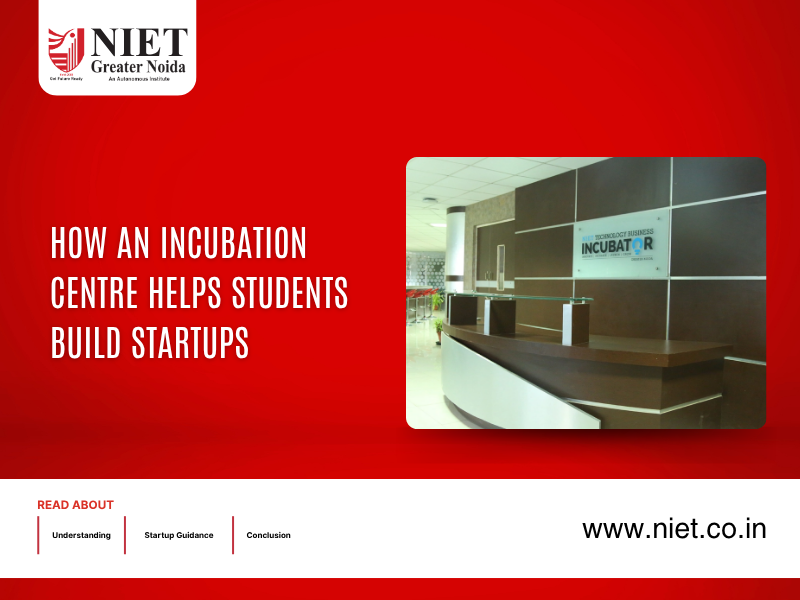
Incubation Centre at NIET - Technology Business Incubator (TBI)
At Noida Institute of Engineering and Technology, Greater Noida, the NIET Technology Business Incubator (NIET TBI) provides an entrepreneurial ecosystem for innovators and emerging startups. NIET TBI has incubated more than 150 startups.
Its flexible incubation model supports ventures across the Idea, Innovation, Launch, and Growth stages. Entrepreneurs can access co-working facilities, mentors, and subject experts.
For students, these resources can provide a structured environment to explore how an academic or technical idea might develop into a practical venture.
Understanding Startup Funding
Funding can become important as a startup develops, but raising capital requires more than finding an investor. Founders need a clear understanding of their solution, customers, business model and how additional resources would be used.
Depending on their stage, startups may explore grants, seed funding or investor support. Incubation centres can help entrepreneurs understand these options and prepare for funding conversations.
NIET TBI's incubation initiatives also include funding guidance, investor connections and fundraising support, giving emerging founders exposure to the financial side of venture development.
Support Beyond the Initial Idea
The needs of a startup change as it develops. Early-stage founders may require idea validation, while later stages can introduce challenges around product development, market entry, customers and growth.
Continued access to mentors, professional networks, and business guidance can help entrepreneurs respond to these changing requirements.
For students, this means incubation is not simply about launching a startup. It is also about learning through experimentation, feedback and practical problem-solving.
Why Colleges Can Be Good Spaces for Entrepreneurship
College provides an environment where learning, experimentation, and collaboration already happen together. Students can identify problems through academic work, connect with peers from different disciplines and explore innovative solutions.
Access to an incubation ecosystem can take this further by connecting academic ideas with mentorship, infrastructure and entrepreneurial guidance. Students can therefore explore entrepreneurship while continuing their education and developing practical skills along the way.
Conclusion
Building a startup requires more than an innovative idea. Students need opportunities to validate solutions, develop prototypes, understand customers, learn from mentors and adapt as their ventures evolve.
An Incubation Centre brings many of these resources together, making the entrepreneurial journey more structured for student founders. Ecosystems such as NIET TBI demonstrate how academic incubation can help students take ideas beyond the classroom and explore what it takes to develop them into practical ventures.
FAQs
What is an incubation centre?
An incubation centre supports early-stage entrepreneurs and startups through resources such as mentorship, infrastructure, networking, prototype development, and business guidance.
How does an incubation centre help students build startups?
It can help students refine ideas, validate business concepts, access mentorship, develop prototypes, understand funding options, and connect with a wider startup ecosystem.
Can students start a business while studying?
Yes. Many students explore entrepreneurship while pursuing their education. An incubation ecosystem can provide relevant guidance and resources to help them develop their ideas alongside their academic journey.
What is the difference between an incubation centre and a startup accelerator?
An incubation centre generally supports early-stage ventures through longer-term guidance and resources, while a startup accelerator typically offers structured and time-bound programmes focused on helping startups achieve growth.


