



 admission@niet.co.in
 +91-8010-500-700

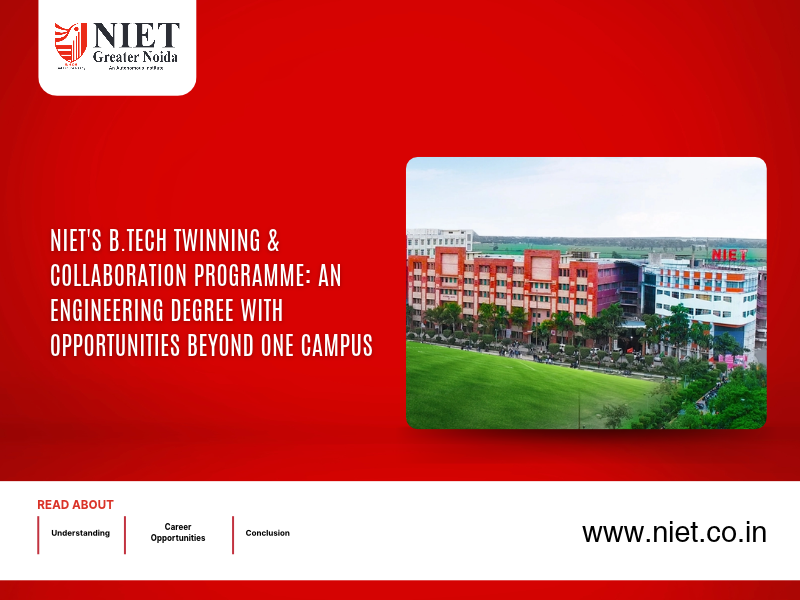
Choosing an engineering college is an important decision for students and their families. Placements, fees, faculty, infrastructure, and career opportunities naturally influence this choice. After all, a B.Tech degree involves four years of learning and a significant investment in a student's future.
But beyond these considerations, another question is worth asking: What opportunities will students have to learn, explore, and grow beyond their regular campus?
At Noida Institute of Engineering and Technology(NIET), Greater Noida, the B.Tech Twinning & Collaboration Programme combines engineering education with opportunities to study at partner universities in India and abroad. The programme aims to broaden students' learning experience by combining academic knowledge, practical skills, and experiences beyond the classroom.
What Makes NIET's B.Tech Twinning & Collaboration Programme Different?
In a conventional B.Tech programme, students generally complete their education at one institution. NIET's Twinning & Collaboration Programme offers a different approach, allowing students to complete an approved part of their studies at a partner university.
The programme covers four B.Tech disciplines:
-
Computer Science and Engineering (CSE): Programming, software development, computing systems and emerging technologies.
-
Information Technology (IT): Software applications, databases, networking and information systems.
-
CSE (Artificial Intelligence): Computer science fundamentals and applications of artificial intelligence.
-
CSE (Artificial Intelligence and Machine Learning): Computing, data-based systems, AI and machine learning applications.
Under the current programme structure, students undertake academic mobility during the fifth semester. Subjects and credits are planned in coordination with partner universities so that approved coursework can count towards their B.Tech degree at NIET.
National and International Mobility: Learning at Universities in India and Abroad
NIET's programme includes both National and International Academic Mobility, offering students opportunities to experience education at different institutions.
Through national mobility, students can experience different teaching methods, interact with faculty and students from other regions, and gain exposure to India's diverse academic and cultural environment.
International mobility offers an opportunity to study in another country, experience different academic practices and interact with people from different cultural backgrounds.
NIET's partnerships and academic engagements extend across India, Malaysia, Indonesia, Taiwan, the UAE, Europe and other regions, involving institutions with expertise in engineering, technology, research and innovation.
Whether within India or overseas, studying at another institution can give students new perspectives on learning, working with others and approaching unfamiliar situations. Available mobility destinations depend on the arrangements for each academic batch.
Academic Quality, Infrastructure and Practical Learning
Good engineering education depends on strong academic foundations, experienced faculty, relevant subjects, laboratories and opportunities to apply what students learn.
NIET's Twinning & Collaboration Programme offers students opportunities to experience the teaching methods, facilities and academic resources of partner universities.
Practical learning is another area of focus. Through GMIP, a project-based learning initiative for mobility students, NIET aims to encourage students to work on practical problems, apply their technical knowledge, and develop solutions through hands-on projects.
This approach is particularly relevant to CSE, IT, AI, and Machine Learning, where practical work and problem-solving play an important role in building technical skills.
Placements and Preparation for Future Careers
Placements remain an important consideration for students and parents. However, employers look beyond academic marks and qualifications. Technical knowledge, communication, teamwork, problem-solving and the ability to learn new skills also matter.
Academic mobility can offer students opportunities to practise these abilities through new assignments, group activities and interactions with unfamiliar classmates and faculty.
Research on academic mobility has found potential benefits in confidence, adaptability and communication across cultures. However, these experiences do not automatically lead to better placements or higher salaries.
For NIET students, mobility and project-based learning offer additional opportunities to gain experience and develop skills that may prove useful in their future careers.
Making Global Education Affordable and Accessible
Studying at a university overseas is often associated with significant expenses, making affordability an important concern for many families.
NIET aims to make global education more affordable and accessible through academic partnerships and mobility programmes supported by the institution.
By including national and international mobility opportunities within its B.Tech programme, NIET seeks to give more students access to educational experiences beyond their home campus, while recognising the financial considerations of students and parents.
Beyond the Classroom: Personal Growth and Student Support
For many students, academic mobility may be their first experience of studying away from home. Managing daily responsibilities, adjusting to a new campus and working with unfamiliar classmates can encourage independence, confidence and adaptability.
NIET's Center for Global Engagement (CGE) works with students, parents and partner universities to coordinate and support the mobility experience.
Before departure, CGE guides students through academic requirements, documentation, university registration, travel and accommodation arrangements, as applicable. For international mobility, this also includes guidance on visa-related formalities. Orientation sessions help students and parents understand the arrangements and expectations.
During the semester, CGE stays connected with students and partner universities, follows up on academic progress and assists with concerns related to students' studies or stay. Parents can also approach CGE for guidance and assistance.
After the semester, CGE works with academic departments and partner institutions to coordinate academic records and credit-transfer formalities, helping students complete the requirements for continuing their B.Tech studies at NIET.
Turning University Partnerships into Student Opportunities
The value of academic partnerships lies in the opportunities they create for students.
In 2026, 211 NIET students participated in national and international academic mobility, reflecting the programme's implementation through actual student participation.
NIET continues to work towards strengthening its partnerships and creating further opportunities for academic learning, practical projects and student development.
An Engineering Degree with a Broader Perspective
Choosing an engineering programme involves more than comparing placements, fees and campus facilities. The learning opportunities available during those four years also deserve attention.
NIET's B.Tech Twinning & Collaboration Programme brings together engineering education, practical learning and opportunities to study at institutions in India and abroad.
For students interested in exploring different academic environments and taking an active role in their learning, the programme offers an opportunity to experience engineering education beyond one campus.
The value of an engineering degree is not measured only by where students study, but also by what they learn, experience, and become along the way.
Frequently Asked Questions
1. What is NIET's B.Tech Twinning & Collaboration Programme?
It is an engineering programme that allows students to undertake an approved part of their studies at a partner university in India or abroad. Eligible subjects and credits are recognised towards their B.Tech degree, according to the applicable academic arrangements.
2. Does the programme offer both national and international mobility?
Yes. The programme includes opportunities to study at partner universities within India and overseas. Available destinations depend on the partnerships and academic arrangements for each batch.
3. Which B.Tech branches are covered?
The programme includes Computer Science and Engineering (CSE), Information Technology (IT), CSE (Artificial Intelligence), and CSE (Artificial Intelligence and Machine Learning).
4. When do students undertake academic mobility?
Under the current programme structure, students undertake mobility during the fifth semester. Subjects and credits are planned with partner universities to meet the applicable academic requirements.
5. How does the programme support practical learning and career preparation?
Along with academic mobility, initiatives such as GMIP aim to offer project-based learning opportunities where students can apply their technical knowledge, work on practical problems, and gain experience working in teams.
6. How does NIET support students during mobility?
NIET's Center for Global Engagement (CGE) supports the coordination of students' mobility arrangements before, during, and after their semester at a partner university.
This includes guidance on documentation, academic requirements, travel, accommodation and visa formalities where applicable. CGE also stays in contact with students and partner universities during mobility and helps coordinate academic records and credit-transfer requirements after the semester.


