



 admission@niet.co.in
 +91-8010-500-700

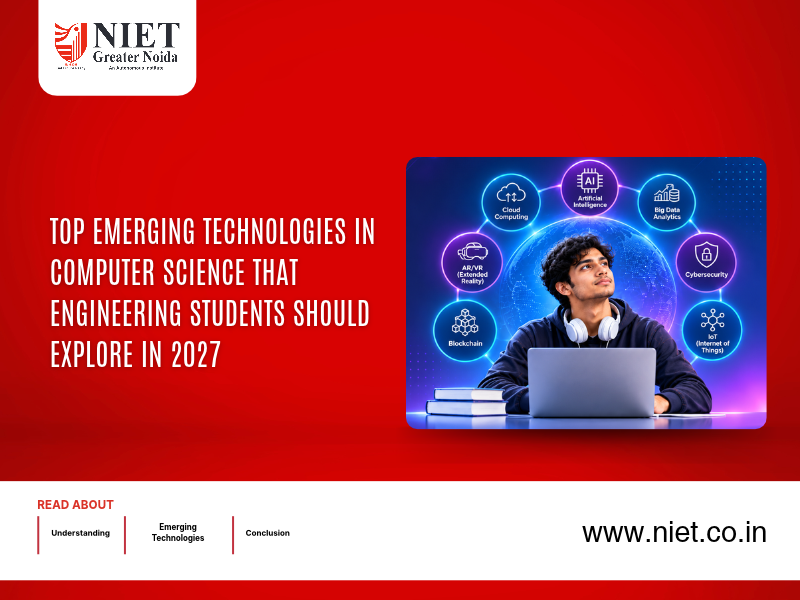
Computer Science is evolving rapidly, with technological advancements transforming how businesses operate, information is processed, and complex problems are solved. From intelligent automation to connected devices, new technologies are introducing possibilities across industries.
Exploring emerging technologies in Computer Science in 2027 can help engineering students strengthen their technical knowledge, identify areas of interest, and understand the practical applications of modern computing.
Top Emerging Technologies in Computer Science for 2027
1. Artificial Intelligence and Machine Learning
Artificial Intelligence (AI) enables computer systems to perform tasks involving reasoning, pattern recognition, and decision-making. Machine Learning (ML) allows systems to learn patterns from data and generate predictions.
Developments in generative AI, AI agents, and responsible AI offer new learning opportunities. Students can begin by developing basic prediction models using Python.
2. Internet of Things and Industrial IoT
The Internet of Things (IoT) connects physical devices through networks, allowing them to collect and exchange information. Industrial IoT applies these technologies to manufacturing, equipment monitoring, and predictive maintenance.
Students can explore IoT through sensor-based projects and microcontroller programming.
3. Robotics and Automation
Robotics combines programming, electronics, and mechanical engineering to develop machines capable of performing specific tasks. Automation enables systems to complete processes with reduced manual intervention.
Students can explore robot programming, sensors, control systems, and simulation tools to understand industrial and autonomous applications.
4. Augmented Reality and Virtual Reality
Augmented Reality (AR) adds digital elements to real-world environments, while Virtual Reality (VR) creates immersive computer-generated experiences.
These technologies have applications in education, healthcare, product design, and industrial training. Students can experiment with interactive 3D applications and virtual simulations.
5. Cloud Computing and Edge Computing
Cloud computing provides access to computing resources such as servers, storage, and software through network-based services. Edge computing processes information closer to its source, reducing latency in suitable applications.
Students can explore cloud platforms, application deployment, and distributed computing fundamentals.
6. Cybersecurity
Cybersecurity focuses on protecting digital systems, networks and information from unauthorised access and security threats. Cloud security, application security and secure software development are important areas worth exploring.
Students can develop relevant knowledge through networking fundamentals, encryption concepts and authorised security exercises.
7. Data Science and Analytics
Data Science combines programming, statistics and analytical techniques to extract meaningful insights from information. Its applications include business forecasting, healthcare analytics and customer behaviour analysis.
Students can develop analytical skills by working with public datasets and creating data visualisations.
8. Computer Vision
Computer Vision enables machines to interpret images and videos. Its applications include object detection, industrial inspection, image recognition and autonomous navigation.
Students can explore image-processing techniques and machine learning models that recognise visual patterns.
9. 5G and Connected Technologies
5G wireless communication supports high-speed connectivity, reduced latency under suitable conditions, and communication between numerous connected devices.
Students interested in this field can explore wireless networking, communication protocols and connected-system architecture.
10. VLSI and Semiconductor Technologies
Very Large Scale Integration (VLSI) focuses on designing integrated circuits containing numerous electronic components. Although primarily associated with electronics engineering, it connects with Computer Science through processor design, embedded systems, and hardware-software integration.
How Can Engineering Students Develop Practical Skills?
Understanding the latest technologies in Computer Science requires a combination of theoretical knowledge and practical experience.
Students can strengthen their technical abilities by:
-
Developing programming skills in Python, Java, or C++.
-
Building a foundation in mathematics, algorithms, and data structures.
-
Working on technology-based projects.
-
Participating in hackathons, workshops, and technical competitions.
-
Exploring open-source tools and documenting project outcomes.
These activities encourage experimentation, analytical thinking, and continuous learning.
Exploring Emerging Technology Research in Engineering Education
Research plays an important role in advancing engineering education and helping students understand the practical applications of emerging technologies. Areas such as Artificial Intelligence and Machine Learning, Industrial IoT, Robotics and Automation, Augmented and Virtual Reality, Cloud and Edge Computing, Computer Vision, 5G Wireless Communication and VLSI are opening new avenues for technical exploration.
Institutions such as the Noida Institute of Engineering and Technology (NIET), Greater Noida, have identified these technologies among their published research areas, reflecting the growing connection between academic learning and technological advancements.
Students can explore relevant curricula, research areas, and practical learning opportunities to deepen their technical understanding and identify fields that align with their academic interests and career aspirations.
Conclusion
Exploring emerging technologies in Computer Science can help engineering students understand modern computing applications and prepare for future technological developments. Rather than focusing solely on popular trends, students should prioritise technical fundamentals, practical projects, and continuous learning to develop knowledge that remains relevant as technology evolves.
Frequently Asked Questions
1. What are the top emerging technologies in Computer Science for 2027?
Key areas include AI, Machine Learning, IoT, Robotics, AR/VR, Cloud Computing, Cybersecurity, Data Science, Computer Vision, 5G, and VLSI.
2. Why should engineering students explore emerging technologies?
Exploring emerging technologies helps students strengthen technical knowledge, understand industry applications, and identify areas for specialisation.
3. What is the difference between IoT and Industrial IoT?
IoT connects physical devices to exchange information, while Industrial IoT applies connected technologies to industrial equipment and manufacturing processes.
4. How can students gain practical knowledge of emerging technologies?
Students can develop technical projects, practise programming, explore relevant tools, and participate in workshops, internships, and hackathons.
5. Which emerging technology research areas are listed at NIET?
NIET's published research areas include AI and ML, Industrial IoT, Robotics, AR/VR, Cloud and Edge Computing, Computer Vision, 5G, and VLSI.


