



 admission@niet.co.in
 +91-8010-500-700

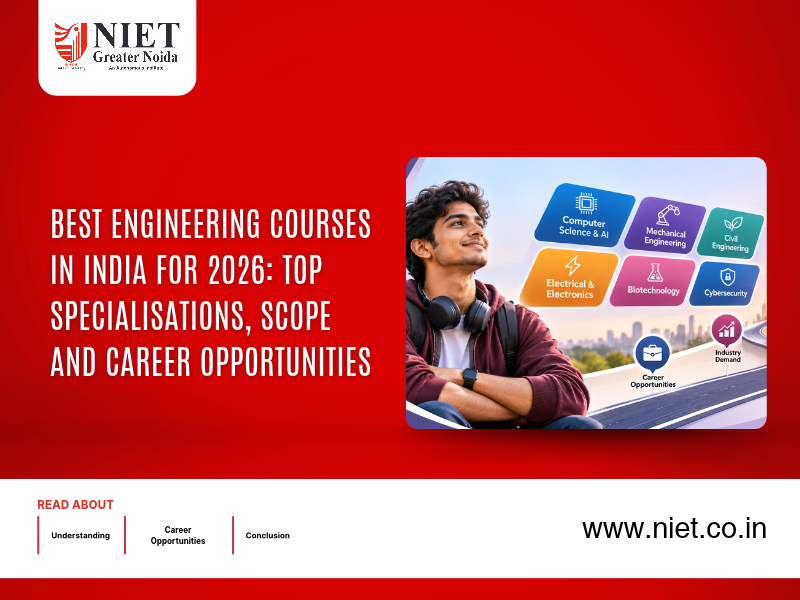
Engineering continues to be a popular choice among students after Class 12, offering opportunities to understand technology, develop practical solutions, and work across different industries. From designing intelligent software and developing electronic systems to building infrastructure and improving manufacturing processes, engineering contributes to several aspects of modern life.
However, engineering education is no longer limited to traditional branches. Alongside Computer Science, Mechanical, Civil, and Electrical Engineering, specialised fields such as Artificial Intelligence, Data Science, Cybersecurity, Robotics, and VLSI Design are gaining attention. With several options available, choosing from the best engineering coursesrequires students to understand the subjects, applications, and career possibilities associated with each discipline.
This guide explores popular engineering branches in India for 2026, emerging specialisations, career opportunities, and important factors to consider before selecting a programme.
Understanding Engineering Education in India
Engineering education combines mathematics, scientific principles, technology, and practical problem-solving. Undergraduate programmes generally lead to a Bachelor of Technology (B.Tech) or Bachelor of Engineering (B.E.) degree, depending on the institution.
Most undergraduate engineering programmes are four years long and divided into eight semesters. Students begin with foundational subjects before progressing to specialised topics related to their chosen branch. Laboratory sessions, technical projects, workshops, and internships may also form part of the learning experience.
Students exploring engineering courses after 12th can consider several disciplines, including:
-
Computer Science and Engineering
-
Electronics and Communication Engineering
-
Electrical Engineering
-
Mechanical Engineering
-
Civil Engineering
-
Biotechnology Engineering
Each branch introduces students to a different area of technology. Understanding these differences can help them identify a programme that matches their academic interests and long-term goals.
Best Engineering Courses to Consider in 2026
The development of technology and changing industry requirements have expanded the scope of engineering education. While traditional branches continue to support essential industries, specialised areas are creating opportunities to explore newer technologies.
Here are some of the best engineering courses in India that students can consider.
1. Computer Science and Engineering (CSE)
Computer Science and Engineering focuses on the development and functioning of computer systems and software applications. Its curriculum commonly covers programming, data structures, algorithms, database management, operating systems, and computer networks.
As businesses increasingly depend on digital platforms and software-based solutions, computer science knowledge is relevant across several sectors.
Students can also explore specialised areas such as:
-
Artificial Intelligence and Machine Learning
-
Data Science and Analytics
-
Cybersecurity
-
Cloud Computing
-
Internet of Things (IoT)
Career areas: Software development, application development, database management, cloud technologies, cybersecurity, and data-related roles.
2. Electronics and Communication Engineering (ECE)
Electronics and Communication Engineering deals with electronic devices, communication networks, signal processing, microprocessors, and embedded systems.
The branch contributes to the development of telecommunications, consumer electronics, automation systems, and semiconductor technologies. Students learn how electronic components and communication systems are designed, tested, and integrated.
With connected devices and communication technologies becoming increasingly important, ECE provides a foundation for understanding modern electronic systems.
Career areas: Electronics design, embedded systems, telecommunications, semiconductor-related work, and communication technology.
3. Electrical Engineering
Electrical Engineering focuses on the generation, transmission, distribution, and utilisation of electrical energy. Students study electrical machines, power systems, circuit analysis, control systems, and electrical measurements.
The discipline supports industries involved in energy production, infrastructure, electric mobility, and industrial automation. It also connects with developing areas such as renewable energy and smart power systems.
Career areas: Power generation, electrical design, renewable energy systems, electrical maintenance, and industrial automation.
4. Mechanical Engineering
Mechanical Engineering involves the design, development, production, and maintenance of machines and mechanical systems. Its curriculum generally includes thermodynamics, engineering mechanics, fluid mechanics, manufacturing technology, machine design, and materials science.
The branch has applications across automobile manufacturing, aerospace, industrial machinery, robotics, and production systems. Students interested in understanding how machines work and how products are designed and manufactured may find this discipline relevant.
Career areas: Product design, manufacturing, automobile engineering, quality control, production planning, and mechanical systems.
5. Civil Engineering
Civil Engineering focuses on the planning, design, construction, and maintenance of infrastructure. Students learn about structural engineering, construction materials, geotechnical engineering, transportation systems, and environmental engineering.
The discipline contributes to the development of buildings, roads, bridges, water supply systems, and public infrastructure. It also involves understanding construction methods, material properties, safety standards, and project requirements.
Career areas: Structural design, construction management, infrastructure development, transportation engineering, and project planning.
6. Biotechnology Engineering
Biotechnology Engineering combines engineering principles with biological sciences. Students may study microbiology, genetics, biochemistry, bioprocess engineering, and industrial biotechnology.
Its applications extend to pharmaceutical development, food processing, agricultural technologies, healthcare-related research, and environmental management. The branch can be suitable for students interested in biology and its technological applications.
Career areas: Bioprocess development, pharmaceutical production, quality control, laboratory research, and biotechnology-related industries.
Emerging Engineering Specialisations in 2026
Apart from established branches, several specialised areas are influencing the direction of engineering education. These programmes introduce students to specific technologies and help them develop knowledge in focused areas.
Some emerging engineering specialisations include:
-
Artificial Intelligence and Machine Learning: Focuses on intelligent systems, predictive models, automation, and algorithms that help computers identify patterns and perform specific tasks.
-
Data Science: Combines programming, statistics, and analytical techniques to interpret large datasets and generate useful insights.
-
Cybersecurity: Deals with protecting digital information, computer networks, applications, and systems against security threats.
-
Internet of Things: Explores connected devices, sensors, and communication technologies that enable physical objects to exchange information.
-
VLSI Design: Introduces students to the design and development of integrated circuits used in electronic devices.
-
Robotics and Automation: Combines mechanical engineering, electronics, and programming to develop automated machines and systems.
These specialised areas often build upon foundational engineering knowledge. Students should review the subjects and practical components of a programme to understand what a particular specialisation involves.
Different Types of Engineering Courses and Their Applications
Understanding the different types of engineering courses becomes easier when students look at how individual branches contribute to real-world projects. Although each discipline has its own academic foundation, modern technological developments often require professionals from multiple engineering backgrounds to collaborate.
For example, developing an electric vehicle involves mechanical design, electrical systems, battery technology, and software. Similarly, smart infrastructure may require civil engineering, electronic sensors, communication networks, and data analysis.
A manufacturing facility using automated production systems may combine mechanical engineering, robotics, electronics, and computer programming.
These examples demonstrate how engineering disciplines are connected. Students should therefore consider not only the subjects covered in a programme but also how the knowledge can be applied across different industries.
Scope and Career Opportunities Across Engineering Branches
One of the important factors students consider while selecting an engineering specialisation is its potential application in the professional world. Different branches provide exposure to different industries, technical responsibilities, and career pathways.
Here is an overview of some possible career roles:
|
Engineering branch |
Potential career roles |
|
Computer Science Engineering |
Software Developer, Systems Engineer, Application Developer |
|
Electronics and Communication Engineering |
Electronics Engineer, Embedded Systems Engineer, Communication Engineer |
|
Electrical Engineering |
Electrical Design Engineer, Power Systems Engineer, Control Engineer |
|
Mechanical Engineering |
Design Engineer, Production Engineer, Quality Engineer |
|
Civil Engineering |
Civil Engineer, Structural Engineer, Site Engineer |
|
Biotechnology Engineering |
Bioprocess Engineer, Research Associate, Quality Control Executive |
Students pursuing specialised fields may also explore roles such as AI Engineer, Machine Learning Engineer, Data Analyst, Cybersecurity Analyst, and VLSI Design Engineer, depending on their technical knowledge and experience.
Career opportunities are influenced by several factors, including practical skills, academic performance, internships, project experience, and employer requirements. Developing a strong technical foundation and staying updated with relevant technologies can help students prepare for changing professional expectations.
How to Choose the Right Engineering Course After 12th
Selecting an engineering branch is an important academic decision. The most popular programme may not necessarily be the right choice for every student. It is useful to compare subjects, learning opportunities, and personal interests before making a decision.
Here are five factors students should consider when exploring the best engineering courses after 12th.
1. Identify Your Academic Interests
Consider the subjects you enjoy studying and the problems you like solving. Students interested in mathematics, programming, and logical reasoning may explore Computer Science, while those interested in machines and physical systems may consider Mechanical Engineering.
2. Understand the Curriculum
Review the syllabus, core subjects, laboratory sessions, and practical components of the programme. Understanding the curriculum can help you assess whether the subjects match your interests and learning preferences.
3. Explore Available Specialisations
Many institutions offer specialised programmes in areas such as Artificial Intelligence, Machine Learning, Data Science, Cybersecurity, and VLSI. Check the programme structure and subjects to understand the knowledge and skills each specialisation is designed to develop.
4. Evaluate Practical Learning Opportunities
Laboratories, workshops, technical projects, internships, and research activities help students apply classroom concepts. Review the practical learning facilities and opportunities available as part of the programme.
5. Check Institutional Recognition and Programme Details
Before applying, review the institution's approvals, accreditation status, faculty information, admission requirements, and academic facilities. Refer to official programme information to understand the course structure and eligibility criteria.
Considering these factors can help students make a more informed choice when comparing engineering programmes.
Exploring Engineering Programmes at NIET Greater Noida
Students looking for engineering education in Greater Noida can explore the undergraduate programmes offered by the Noida Institute of Engineering and Technology (NIET).
The institute offers engineering programmes across areas including Computer Science and Engineering, Information Technology, Electronics and Communication Engineering, Mechanical Engineering, and Biotechnology, along with specialised CSE programmes. These academic options allow students to explore different areas of engineering based on their interests and educational goals.
Before selecting a programme, prospective students should review its curriculum, eligibility requirements, specialisation details, and practical learning components. Understanding these aspects can help them evaluate whether a particular course aligns with their academic interests.
For updated information about available programmes and admission requirements, students can visit the official NIET website.
Conclusion
Engineering education offers several academic pathways, ranging from established disciplines such as Mechanical, Civil, Electrical, and Electronics Engineering to specialised fields such as Artificial Intelligence, Data Science, Cybersecurity, and VLSI Design.
The best engineering courses in India are not necessarily the ones that attract the most attention. The right choice depends on a student's interests, academic strengths, preferred subjects, and long-term goals.
Before selecting a branch, students should compare the curriculum, practical learning opportunities, industry applications, and available specialisations. Taking the time to understand these factors can help them choose an engineering programme that provides a strong foundation for further learning and professional development.
Frequently Asked Questions
1. Which are the best engineering courses in India for 2026?
Popular choices include Computer Science, Mechanical, Civil, Electrical, Electronics and Communication, and Biotechnology Engineering. AI, Data Science, and Cybersecurity are also emerging specialisations.
2. Which engineering courses can students pursue after Class 12?
Students can pursue B.Tech or B.E. programmes in Computer Science, Mechanical, Civil, Electrical, Electronics and Communication, and other branches, depending on eligibility.
3. Which engineering branch offers diverse career opportunities?
Computer Science offers opportunities in software development, cloud computing, data technologies, and cybersecurity. Other branches also provide career options across specialised industries.
4. What is the difference between traditional engineering branches and emerging specialisations?
Traditional branches focus on core disciplines such as Mechanical, Civil, and Electrical Engineering, while emerging specialisations cover areas such as AI, Data Science, and Cybersecurity.
5. How should students choose the right B.Tech specialisation?
Students should consider their interests, academic strengths, course curriculum, practical learning opportunities, and future career goals.
6. Which engineering programmes are available at NIET Greater Noida?
NIET offers programmes in Computer Science, Information Technology, Electronics and Communication, Mechanical, and Biotechnology Engineering, along with specialised CSE programmes.


