



 admission@niet.co.in
 +91-8010-500-700

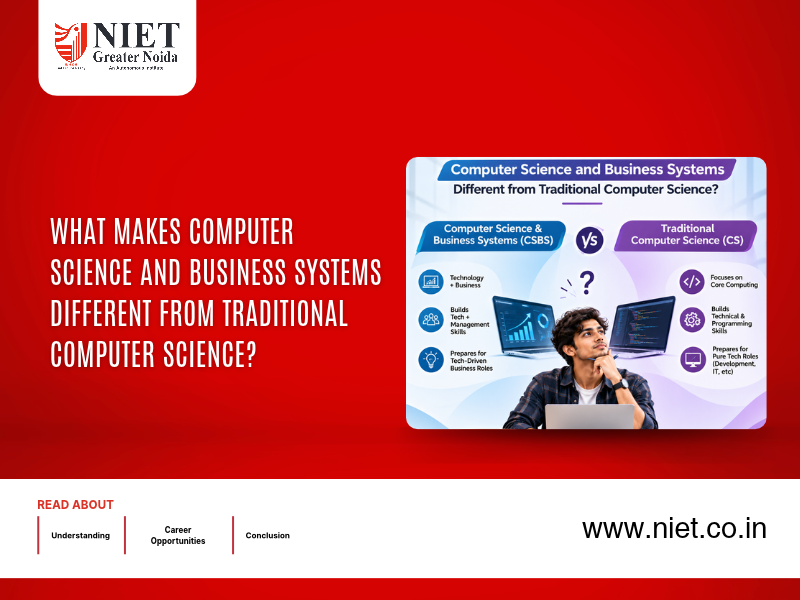
Technology is no longer limited to developing software or managing computer systems. Businesses across industries use technology to analyse data, improve operations, understand customer behaviour, and make informed decisions. This growing connection between technology and business has increased interest in Computer Science and Business Systems (CSBS), an engineering programme that combines computing fundamentals with business-oriented learning.
While traditional Computer Science and Engineering (CSE) focuses primarily on computing concepts and software development, CSBS introduces students to how these technologies are applied in business environments. Understanding the difference between the two can help students choose a programme that aligns with their interests and career goals.
Understanding Computer Science and Business Systems (CSBS)
Computer Science and Business Systems is an interdisciplinary engineering programme that brings together computer science concepts and business applications. It aims to help students understand both the technical aspects of technology and the role technology plays in solving organisational challenges.
Along with programming and computing fundamentals, the programme introduces business-related concepts, analytical thinking, and technology-driven problem-solving. This combination helps students understand how digital solutions can support business decisions and improve organisational processes.
For example, a company may use data analytics to understand customer preferences, databases to manage information, and software applications to improve its services. CSBS helps students explore the technological concepts behind these applications while understanding their business relevance.
CSBS vs Traditional Computer Science: Key Differences
Although CSBS and traditional CSE share several foundational subjects, their academic focus and learning approaches differ.
|
Comparison Factor |
Computer Science and Business Systems (CSBS) |
Traditional Computer Science (CSE) |
|
Academic Focus |
Combines computing fundamentals with business applications. |
Focuses on computing principles and software systems. |
|
Technical Learning |
Covers programming, databases, analytics, and other computing concepts. |
Emphasises programming, algorithms, operating systems, and software development. |
|
Business Exposure |
Introduces business processes, management concepts, and analytical applications. |
Primarily focuses on technical and computational concepts. |
|
Problem-Solving Approach |
Connects technical solutions with organisational requirements. |
Focuses on developing efficient technical solutions. |
|
Learning Perspective |
Integrates technology with business-oriented thinking. |
Builds deeper understanding of computer science and computing systems. |
The key distinction is not that one programme is more technical than the other. Both develop important computing skills. However, CSBS connects technical knowledge with business applications, while traditional CSE offers a broader foundation in computer science and its technical areas.
What Subjects Are Covered in a CSBS Course?
A Computer Science and Business Systems course combines technical subjects with business-oriented concepts. The exact curriculum may vary depending on the institution, but students can explore areas such as:
-
Programming and Data Structures: Develops the ability to write code, organise information, and solve computational problems.
-
Database Management: Introduces methods of storing, managing, and retrieving information used by organisations.
-
Software Engineering: Covers the principles involved in designing, developing, testing, and maintaining software applications.
-
Business Analytics: Helps students understand how data can be interpreted to support business decisions.
-
Cloud Computing: Introduces cloud-based technologies used for data storage, computing, and digital services.
-
Machine Learning: Explores how computer systems can identify patterns in data and support automated decision-making.
Alongside technical learning, business-oriented subjects help students understand organisational requirements, communication, and decision-making. This combination encourages students to look at technology from both technical and practical perspectives.
How CSBS Connects Technology with Business
One of the defining aspects of Computer Science and Business Systems is its focus on applying computing knowledge to real-world business situations.
Consider a retail organisation that wants to improve its customer experience. Data analytics can help identify purchasing patterns, database systems can organise customer information, and software applications can simplify inventory management. Each solution involves technical knowledge as well as an understanding of business requirements.
Similarly, financial organisations use digital systems to process transactions, analyse information, and improve operational efficiency. Healthcare organisations rely on information systems to manage records and support administrative processes.
Through this interdisciplinary approach, students learn to understand problems beyond their technical requirements and explore how technology can address wider organisational needs.
Scope and Career Opportunities After CSBS
The scope of Computer Science and Business Systems extends across industries where technology and business operations work together. Depending on their technical knowledge, practical experience, projects, and specialisation, graduates can explore roles such as:
-
Software Developer: Develops and maintains software applications.
-
Business Analyst: Studies business requirements and identifies areas where technology can improve processes.
-
Data Analyst: Examines datasets to identify patterns and generate useful insights.
-
IT Consultant: Helps organisations understand and implement technology solutions.
-
Systems Analyst: Evaluates existing systems and recommends improvements.
-
Project Coordinator: Supports the planning, coordination, and execution of technology-related projects.
Students can strengthen their career prospects by developing programming skills, working on practical projects, learning data analysis tools, and gaining internship experience. The opportunities available will depend on individual skills and employer requirements.
Studying Computer Science and Business Systems at NIET Greater Noida
For students interested in combining technical education with business-oriented learning, selecting an institution with a relevant academic structure and practical learning opportunities is important.
The Noida Institute of Engineering and Technology (NIET), Greater Noida, offers the Computer Science and Business Systems programme in association with Tata Consultancy Services (TCS). The programme brings together computer science fundamentals and business-related learning to help students understand the application of technology in organisational environments.
Students considering the programme should review its latest curriculum, academic structure, practical learning components, and eligibility requirements before making a decision.
Is CSBS the Right Choice for You?
CSBS can be a suitable option for students who enjoy technology but are also interested in understanding how businesses operate. It may appeal to those who want to explore programming, data analysis, business applications, and technology-driven problem-solving.
On the other hand, students who want to focus more deeply on areas such as algorithms, computer architecture, operating systems, and software engineering may prefer exploring traditional CSE.
The right choice ultimately depends on your interests, preferred learning approach, and long-term career objectives. Reviewing the curriculum and understanding the academic focus of each programme can help you make a more informed decision.
Conclusion
Computer Science and Business Systems offers an interdisciplinary approach to engineering education by connecting computing knowledge with business applications. While traditional CSE builds a strong foundation in computer science, CSBS introduces an additional perspective on how technology supports organisational needs.
Both programmes offer opportunities to develop technical skills and explore technology-driven careers. Students should compare their subjects, learning approaches, practical exposure, and personal interests before selecting the programme that best supports their goals.
Frequently Asked Questions (FAQs)
1. What is Computer Science and Business Systems (CSBS)?
Computer Science and Business Systems is an engineering programme that combines computer science fundamentals with business-oriented concepts, helping students understand how technology can address organisational requirements.
2. How is CSBS different from traditional CSE?
CSBS combines computing subjects with business applications, while traditional CSE primarily focuses on computer science concepts, programming, algorithms, and software systems.
3. What subjects are taught in a CSBS course?
Subjects may include programming, data structures, database management, software engineering, business analytics, cloud computing, and machine learning, depending on the institution's curriculum.
4. What is the career scope after CSBS?
Graduates can explore opportunities in software development, business analysis, data analytics, IT consulting, and systems analysis, depending on their skills and experience.
5. Is CSBS a good choice for students interested in both technology and business?
Yes. It can be suitable for students who want to develop technical knowledge while understanding business processes and the practical applications of technology.


