



 admission@niet.co.in
 +91-8010-500-700

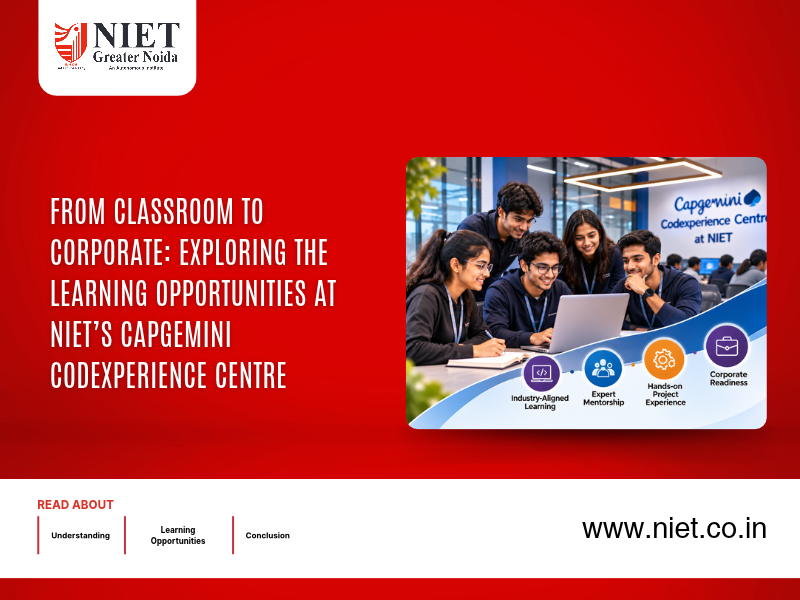
Engineering education is evolving beyond textbooks and theoretical concepts. Today, students need opportunities to apply their knowledge, work on practical challenges, collaborate with peers, and understand professional expectations. The Capgemini CodeXperience Centre at Noida Institute of Engineering and Technology (NIET), Greater Noida, reflects this shift by bringing industry-oriented learning closer to the academic environment.
Designed around the connection between classroom learning and corporate practices, the Capgemini CodeXperience Centre at NIET aims to help students understand how technology professionals learn, develop solutions, and collaborate in real-world work environments.
Why Is Industry-Oriented Learning Important in Engineering?
A strong academic foundation helps engineering students understand programming, algorithms, software development, and other technical concepts. However, applying this knowledge to practical situations requires a different set of skills.
Industry-oriented learning helps students connect theoretical understanding with practical execution. It encourages them to approach problems logically, work in teams, explore different solutions, and become familiar with professional methods of working.
Through this approach, students can develop technical knowledge alongside communication, collaboration, and problem-solving abilities that are relevant to technology-driven industries.
From Learning Concepts to Building Solutions
The learning journey envisioned at the NIET Capgemini Centre follows a progression that takes students from understanding technical concepts to applying them in practical settings.
The centre's learning approach is organised around six stages:
-
Learn: Strengthen technical foundations through structured, industry-oriented learning experiences.
-
Practice: Apply concepts through coding exercises and hands-on technology activities.
-
Collaborate: Exchange ideas, work in teams, and approach challenges through shared problem-solving.
-
Build: Develop projects and solutions that encourage practical application of technical knowledge.
-
Experience: Understand professional workflows, workplace practices, and technology-driven project environments.
-
Grow: Continue developing technical and professional capabilities relevant to the changing technology landscape.
This progression encourages students to move beyond simply understanding concepts and explore how they can be used to develop practical solutions.
What Makes the Capgemini CodeXperience Centre Different?
The Capgemini Centre Greater Noida represents an industry-academia learning initiative that brings together NIET's academic environment and Capgemini's industry perspective.
One of its key learning aspects is the emphasis on connecting theoretical knowledge with practical activities. Coding challenges, collaborative exercises, and project-based learning can help students understand how technical concepts are applied to different problems.
The centre also introduces students to professional ways of working, including team collaboration, project workflows, and the use of collaborative tools. Such exposure can help students become more familiar with the expectations of technology-driven workplaces.
Rather than treating technical learning and professional development as separate activities, this approach brings them together within the engineering education environment.
Skills Students Can Develop Through Practical Learning
Practical learning opportunities play an important role in preparing engineering students for professional environments. The learning model outlined for the centre focuses on developing capabilities across several areas.
-
Technical Skill Development: Coding exercises and technology-based activities encourage students to strengthen their programming knowledge and apply technical concepts.
-
Problem-Solving: Working through challenges helps students analyse situations, identify possible solutions, and approach tasks systematically.
-
Team Collaboration: Group activities provide opportunities to exchange ideas, coordinate responsibilities, and learn from different perspectives.
-
Project-Based Understanding: Building solutions helps students understand how individual technical concepts contribute to a larger project.
-
Corporate Learning Exposure: Familiarity with professional workflows and collaborative tools can help students understand how technology teams function in organisational settings.
Together, these areas contribute to a more application-oriented approach to engineering education.
Strengthening the Connection Between Industry and Academia at NIET
The Capgemini CodeXperience Centre at NIET reflects an effort to bring industry perspectives into the campus learning environment. By combining academic foundations with applied learning and professional practices, the initiative aims to create a more connected educational experience.
Located at NIET, Knowledge Park II, Greater Noida, the centre forms part of the institute's broader approach to industry-academia engagement.
For students, understanding how technical knowledge translates into professional applications can be an important part of preparing for future opportunities. Initiatives that encourage practical learning, collaborative problem-solving, and exposure to industry workflows can help make this transition more meaningful.
Conclusion
The transition from classroom learning to professional work requires more than theoretical knowledge. Students also need opportunities to practise, collaborate, build solutions, and understand how technology is used in professional environments.
The Capgemini CodeXperience Centre at NIET brings these learning elements together through an industry-oriented approach. By connecting technical foundations with practical activities and corporate learning exposure, it aims to help students develop a broader understanding of engineering and its applications in the technology sector.
Frequently Asked Questions (FAQs)
1. What is the Capgemini CodeXperience Centre at NIET?
It is an industry-integrated learning initiative at NIET, Greater Noida, designed to connect academic learning with practical technology activities and professional working methods.
2. Why is industry-oriented learning important for engineering students?
It helps students apply theoretical concepts, strengthen problem-solving abilities, work collaboratively, and understand how technical knowledge is used in professional environments.
3. What learning activities are associated with the centre?
The learning model includes coding exercises, hands-on technology activities, collaborative problem-solving, project development, and exposure to professional workflows.
4. What skills can students develop through practical learning?
Students can work on programming, technical problem-solving, teamwork, project development, communication, and familiarity with professional practices.
5. Where is the Capgemini CodeXperience Centre located?
The centre is located at Noida Institute of Engineering and Technology (NIET), Knowledge Park II, Greater Noida, Uttar Pradesh.


